 |
|||||||
 |
 |
 |
 |
 |
|||
| ll | |||||||
|
|
|||||||
| Hypothesis:
That most of the nematode diversity in the tropical rainforest is found
in arboreal habitats and the associated invertebrates, as compared with
the concentration of biodiversity found in temperate grassland soils. (NSF
Biodiversty Surveys and Inventories #0450537)
|
|||||||
|
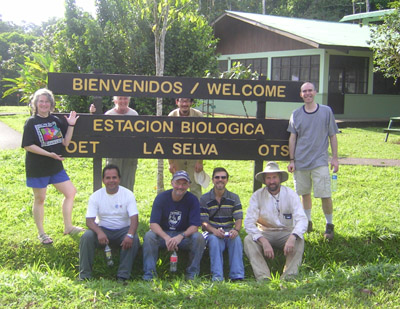
Testing: We conducted a survey of nematode diversity in the humid lowland tropical rainforest of Costa Rica. Samples of soil,
forest floor litter and understory habitats (insects and epiphytes) were
collected from the La Selva Biological Station, Costa Rica. All nematode
taxa were identified morphologically, with some unusual or unique phenotypes
characterized by molecular metrics. Molecular Operational Taxonomic Units
(MOTU's) determined by amplification of barcode
region and sequence
assessment.
|

|
||||||
|
|||||||
|
Results of the Nematode Survey:
Molecular analysis (measured by SSU ribosomal diagnostic region using single-nematode PCR and sequencing) of 360 nematodes (120 per each habitat) revealed 167 distinct MOTUs, only 6 of which identically matched the GenBank entries. Estimated total “species” richness ranged from 464 to 502 and sampling efficiency curves indicated that only 22-30% of the nematode species have been recovered from the soil, litter, and understory habitats. As much as 62% of the genetic diversity existed in litter and understory habitats and was not recovered from soil samples, indicating that previous estimates of tropical nematode diversity were low because habitats above the mineral soil were not included in sampling designs.
Nematode Survey |
|||||||
